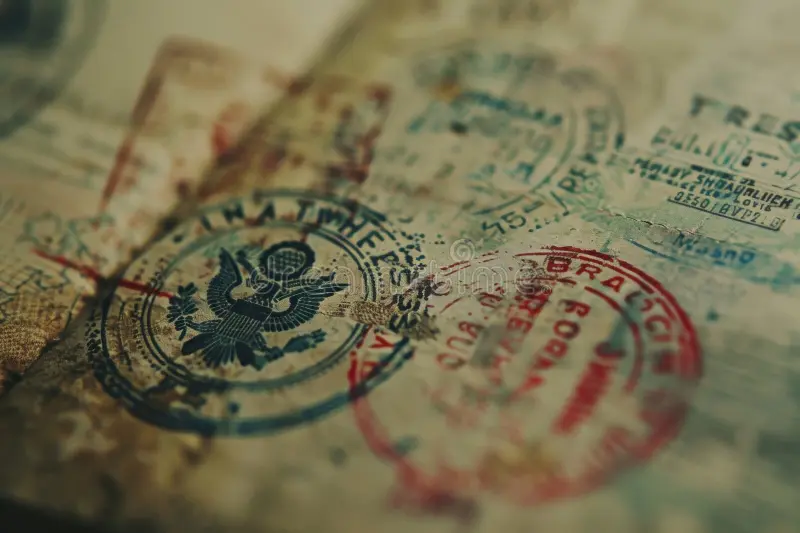
The relentless march of efficiency claims another victim: the romance of the border crossing.

In 2020, as I prepared for a trip to Asia with my brothers, I flipped through my expiring passport before surrendering it to the State Department. It was a chaotic, ink-stained ledger of the previous decade.
There was my first stamp from Costa Rica, where I had tagged along on my father’s business trip (and where he had the occasion to meet the country’s president). There was the ink from a high-school graduation trip near the Canadian border, a collegiate hike through Peru, and a post-university backpacking excursion with my friend before we surrendered our freedom to the corporate world.
Each stamp provided a quiet sense of satisfaction, tangible proof of my worldliness and a prelude to a story. My current decade of travel will leave no such paper trail.
As a computer scientist and engineer, I have spent my career pursuing the very efficiency gains that are rendering those stamps obsolete. The ruthless optimization of global industries grows the world’s wealth and raises living standards. It allows today’s middle class to travel with an ease that prior generations could scarcely imagine.
In our ever-present push to optimize, we are casually discarding the tangible artifacts of our lives. The serendipity of the paper road map has been replaced by the routing efficiency of the smartphone. Unique local storefronts are quietly replaced by optimized global supply chains. And now, the physical record of border crossing is being outsourced to a database.
My wife and I recently traveled to Spain and England. Landing in Barcelona, we bypassed the traditional customs officer entirely. We were processed by an automated biometric e-gate that scanned our microchips and quietly cleared us for entry. Gone are the days of filling out a visa form with pen and paper and interacting with a host nation’s representative.
When we left Spain and landed in England, we encountered the same automated queues. Deciding to break with modern protocol, I approached a border agent and asked for a physical stamp. My wife is pregnant, and I wanted a small, physical record of our unborn son’s first trip across the pond. The request was denied. The machine had spoken.
To be sure, digitizing travel records makes economic sense. Frictionless transit reduces queue times and lowers overhead for border agencies, and travelers certainly don’t miss standing in a two-hour line.
To the modern bureaucrat, every inefficiency is a deadweight loss. But occasional friction is a cultural tax worth paying.
Culture, whimsy, and history are not free. They require a deliberate willingness to occasionally reject the most optimized path. Just as a neighborhood is ultimately better off supporting a unique local storefront over a marginally cheaper global chain, society is better off bearing a few minor costs for the sake of culture and posterity.
We do not need to be Luddites to recognize that efficiency should serve humanity. If we must automate border entry, surely we can program a machine at the end of the corridor to forcefully thwack a physical stamp onto a paper page. We should demand it.
We live in an era where our personal histories are increasingly outsourced to the cloud–recorded in ephemeral social media feeds and invisible servers. But a database cannot be stumbled upon in a desk drawer decades from now. Tangible artifacts, whether a well-worn map, a local matchbook, or an ink-stained passport are the messy receipts of our curiosity.
In our rush to relentlessly optimize the world, we must occasionally sacrifice efficiency to leave behind the evidence that we actually enjoyed it.